Article Summary: Iran's national internet filtering system is managed by multiple government bodies including FATA (the Cyberspace Police) and the Committee Charged with Determining Offensive Content. It blocks a wide range of platforms and services using layered technical mechanisms. This tool provides a DNS-based heuristic test to check whether a domain appears blocked from within Iran.
What Is the Iran Firewall Test?
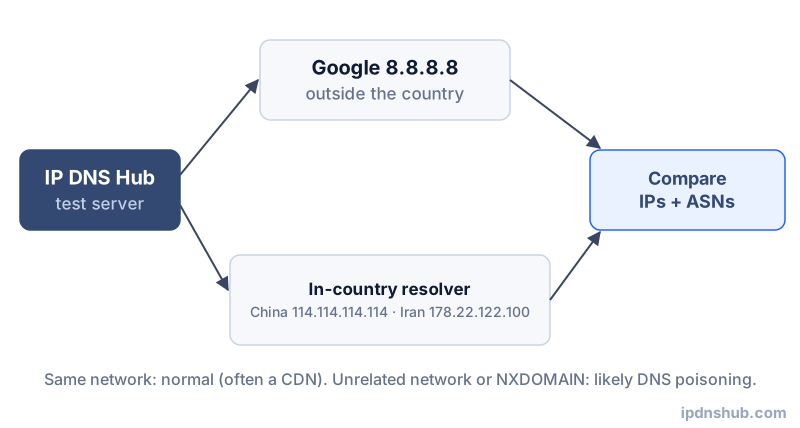
The Iran Firewall Test tool checks whether a domain is accessible from within Iran by comparing DNS query results from two resolvers: Google Public DNS (8.8.8.8) and Shecan (178.22.122.100), a widely used Iranian DNS resolver. If Shecan answers with a private block-page address (such as 10.10.34.36), returns no answer, or points to a network unrelated to Google's answer, the domain is flagged as filtered by Iran's national internet filtering infrastructure. Different addresses that belong to the same network are normal for CDN-hosted sites and are not counted as a block.
Iran's internet censorship system is among the most extensive in the world. It affects millions of Iranians who rely on circumvention tools like VPNs and proxies to access everyday services including Instagram, WhatsApp (at times), YouTube, Twitter/X, and Facebook. For international businesses and developers, understanding whether their platform reaches Iranian users is critical for audience analytics and accessibility planning.
Unlike a simple ping test, this tool specifically targets the DNS layer — the most common enforcement point for Iran's filtering system. DNS blocking redirects queries for banned domains to a government-controlled IP or simply returns no result, making sites effectively unreachable for users who rely on standard ISP-provided resolvers.
How It Works
DNS-Based Filtering Detection
When an Iranian ISP receives a DNS query for a blocked domain, it intercepts the query and either returns a null response (NXDOMAIN), a redirect to a government warning page IP, or simply drops the packet. By comparing the response from Shecan against Google's response, the tool looks for these specific signs. In our own checks, Shecan answered well-known filtered domains such as facebook.com, twitter.com and bbc.com with 10.10.34.36 — a private, non-routable address used for the block page — while unfiltered sites resolved to normal public addresses.
Shecan as a Reference Resolver
Shecan (178.22.122.100) is a public DNS service operated in Iran and widely used there. It is not a circumvention tool for government filtering: it applies the national filtering rules and answers blocked domains with the block-page address. That makes it a practical reference point for what users on Iranian networks see at the DNS level. Keep in mind that a single resolver is a sample, not the whole country — individual ISPs can differ.
Beyond DNS: Other Filtering Techniques
Iran also uses deep packet inspection (DPI) to detect and block certain protocols and encrypted traffic patterns, particularly VPN protocols. IP-level blocking is applied to entire IP ranges associated with blocked services. SNI blocking allows filtering of HTTPS sites based on the hostname in the TLS handshake. A clean DNS result from this tool does not guarantee full accessibility — it is a first-layer heuristic check.
Iran vs China Internet Censorship
Both Iran and China operate large-scale national internet filtering systems, but they differ significantly in scope, technical sophistication, and governance.
China's Great Firewall (GFW) is technically more advanced, employing AI-driven deep packet inspection, BGP-level route injection, and highly dynamic blocklist updates. The GFW is tightly integrated at the carrier infrastructure level across all major ISPs, making circumvention technically difficult. Iran's system, by contrast, is somewhat less centralized and more reliant on ISP-level DNS blocking and IP filtering, though it has incorporated DPI capabilities over time.
In terms of scope, China blocks almost all major Western social media and communication platforms, while Iran's blocking is similarly extensive but has more variability — some platforms are periodically unblocked and re-blocked based on political events. Iran's National Information Network (NIN), also called the National Internet or "SHOMA," is an ongoing government project to build a domestic alternative internet that could theoretically function independently of the global internet during political crises.
Both countries enforce their filtering through mandatory ISP compliance. ISPs that fail to block mandated domains risk losing their operating licenses. In Iran, this is overseen by the Ministry of Information and Communications Technology (ICT) and the Cyberspace Police (FATA).
Common Use Cases
Global SaaS Accessibility Monitoring
SaaS companies with Iranian user segments use this test to monitor whether their domain remains accessible without VPN. A sudden block can silently drop a significant portion of active users, and monitoring DNS resolution from Iranian resolvers is the fastest way to detect this.
Media and Journalism Accessibility
International news organizations frequently check whether their domains are filtered in Iran. This is relevant for editorial strategy — if a site is blocked, readers in Iran must use mirror domains or VPN access, which affects audience metrics and distribution planning.
Developer and API Service Reachability
Developers building applications for users in Iran need to verify whether their API endpoints, CDN origins, and authentication servers are reachable without circumvention tools. A blocked API endpoint can silently break apps for Iranian users without any server-side error logs.
Technical Reference: Iran's Internet Filtering System
| Aspect | Detail |
|---|---|
| Governing Body | FATA (Cyberspace Police) + Committee Charged with Determining Offensive Content (CCDOC) |
| Filtering Methods | DNS blocking, IP blocking, deep packet inspection (DPI), SNI-based filtering, protocol blocking |
| Major Blocked Categories | Social media, political and news content, VoIP services, adult content, gambling, anti-government content |
| Blocked Examples | Instagram (periodically), WhatsApp (periodically), Twitter/X, YouTube, Facebook, Telegram (partially) |
| ISP Compliance | Mandatory for all licensed ISPs; non-compliance results in license revocation |
Frequently Asked Questions
Who controls internet filtering in Iran?
Internet filtering in Iran is overseen by two primary bodies: FATA (the Cyberspace Police, part of the Iranian police force) handles enforcement and monitoring, while the Committee Charged with Determining Offensive Content (CCDOC) — a multi-ministry committee — makes formal decisions about which content and domains should be blocked. The Ministry of ICT implements these decisions at the ISP level.
Which social media sites are blocked in Iran?
As of the current period, Facebook, Twitter/X, YouTube, and Telegram are persistently blocked in Iran. Instagram and WhatsApp have been blocked repeatedly during periods of political unrest, particularly during protests. LinkedIn has historically been blocked and unblocked multiple times. The situation is dynamic and subject to change based on political events.
What is the National Information Network (NIN)?
The National Information Network (NIN), referred to in Farsi as "Shabake-ye Melli-ye Ettelaat," is Iran's domestic intranet project. The goal is to build a government-controlled internal network for hosting Iranian services — including government portals, banking, and domestic social platforms — that would continue to function even if Iran were cut off from the global internet. It is part of Iran's long-term strategy for internet sovereignty.
Can Iranians use VPNs legally?
The legal status of VPNs in Iran is complex. Using a VPN to access filtered content is technically illegal under Iranian law. However, enforcement against individual users has historically been limited. The government periodically crackdowns on VPN providers and apps available on domestic app stores, and during protests it often throttles or blocks VPN protocols at the network level. Many Iranians use VPNs daily despite the legal risk.
How do I check if my site is blocked without being in Iran?
The most accessible method is using a tool like this one, which performs a DNS comparison between an international resolver and an Iranian resolver. For more comprehensive testing, you can use services that maintain probe nodes inside Iran, or compare your domain's resolution against known blocklists. This tool's DNS comparison approach is fast, requires no local installation, and catches the most common form of Iran internet filtering.
Conclusion and Takeaways
Iran's internet filtering system is a significant barrier for international platforms, journalists, and businesses that want to reach Iranian users. Understanding the mechanisms — DNS blocking, IP filtering, DPI — and testing for them proactively helps teams make informed decisions about infrastructure, mirror domains, and communication strategies for audiences inside Iran. Use this tool as your first check, and combine it with VPN-based testing for a complete picture of your site's accessibility.
Ready to Test?
Use the Iran Firewall Test above — no login required, instant results.