Article Summary: Subdomain discovery uncovers the full DNS namespace of a domain, revealing services and infrastructure that may not be publicly advertised. This article explains how subdomain enumeration works, what the most common subdomains are and their security implications, the risks of subdomain takeover, and how passive DNS differs from active DNS brute force.
What Is Subdomain Discovery?
A subdomain is a prefix label attached to a root domain, separated by a dot. For example, api.example.com and staging.example.com are both subdomains of example.com. Each subdomain can be configured independently in DNS to point to different servers, cloud services, or content delivery networks.
Subdomain discovery — also called subdomain enumeration — is the systematic process of identifying all subdomains that exist for a given domain. Organizations rarely publish a complete list of their subdomains, so discovery tools use several complementary techniques: active DNS brute force, passive DNS observation, certificate transparency (CT) log mining, and web crawling.
For defenders, subdomain discovery is a core component of attack surface management — you cannot protect what you do not know exists. For penetration testers and bug bounty hunters, subdomain enumeration is one of the first steps in reconnaissance, often revealing forgotten test environments, exposed admin panels, or vulnerable legacy applications that were never properly decommissioned.
How It Works
Passive DNS Observation
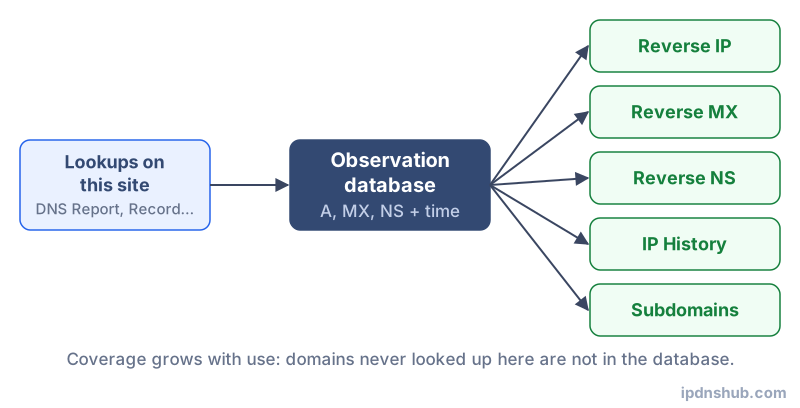
Passive DNS refers to recording DNS query responses as observed at recursive resolvers or DNS sensors. When any user around the world resolves a subdomain, that resolution event is logged. Aggregated across millions of resolvers, passive DNS builds a comprehensive database of subdomains that have been seen in real-world DNS traffic — without ever directly querying the target's authoritative DNS server.
Certificate Transparency Logs
Every publicly trusted TLS/SSL certificate must be submitted to a Certificate Transparency (CT) log, a public, append-only record. CT logs contain the Subject Alternative Names (SANs) of every certificate, which typically list all subdomains the certificate covers. Tools like crt.sh allow you to query these logs to surface subdomains that have had a certificate issued — a highly effective passive enumeration source.
DNS Brute Force
Active DNS brute force works by taking a wordlist of common subdomain names (www, mail, api, admin, dev, staging, and thousands of others) and performing DNS A/AAAA record lookups for each candidate. Any that resolve to an IP address are confirmed as active subdomains. This technique is fast and comprehensive but generates DNS traffic that may be detected by the target's monitoring systems.
Web Crawling and Search Engines
Search engine caches, web archive crawls, and JavaScript resource references embedded in web pages frequently reveal additional subdomains that passive DNS and CT logs may have missed. Combining multiple sources produces the most complete picture of a domain's subdomain inventory.
Common Use Cases
Attack Surface Management
Security teams perform regular subdomain discovery against their own domains to maintain an accurate inventory of externally accessible services. Forgotten shadow IT — test servers, proof-of-concept environments, and acquired subsidiary domains — often persists long after its usefulness has ended, creating exploitable gaps in security coverage.
Penetration Testing Reconnaissance
In a penetration test, subdomain enumeration is performed during the reconnaissance phase to identify all in-scope targets. A staging subdomain with debug logging enabled, a dev subdomain running an unpatched CMS, or an admin subdomain without IP allowlisting are common high-value findings that never appear in the main www site.
Bug Bounty Hunting
Bug bounty hunters systematically enumerate subdomains of program targets to find overlooked or recently deployed applications. Many critical vulnerabilities — including exposed API keys, unauthenticated dashboards, and subdomain takeovers — are discovered through thorough subdomain enumeration on properties that the organization's internal security team was unaware of.
Common Subdomain Naming Conventions
| Subdomain | Typical Use | Security Risk Level |
|---|---|---|
| www | Primary public website | Low — usually well-maintained |
| Webmail client or mail server | Medium — credential exposure if unpatched | |
| smtp | SMTP relay endpoint | Medium — open relay risk if misconfigured |
| ftp | File transfer server | High — often misconfigured, supports anonymous access |
| vpn | Remote access gateway | High — exploitable if unpatched (e.g. Pulse Secure, Fortinet CVEs) |
| admin | Administration panel | Critical — should never be publicly accessible |
| api | REST/GraphQL API endpoint | High — authentication bypass, IDOR, over-permissive CORS |
| dev | Development environment | Critical — often lacks authentication, exposes source or debug data |
| staging | Pre-production testing environment | High — production-like data, weaker access controls |
| test | QA or testing server | High — frequently forgotten after project completion |
| portal | Customer or partner portal | Medium — depends on authentication strength |
| cdn | Content delivery network origin | Medium — misconfigured CDN can enable cache poisoning |
| static | Static asset hosting | Low — risk increases if writable by third parties |
Subdomain Discovery for Security
From a security perspective, every subdomain represents an additional entry point into an organization's infrastructure. Attack surface reduction involves identifying and eliminating subdomains that are no longer needed, ensuring that remaining subdomains are properly secured with TLS, authentication, and patch management.
One of the most impactful findings enabled by subdomain enumeration is a subdomain takeover vulnerability. This occurs when a subdomain's DNS record points to a third-party service (such as GitHub Pages, Heroku, Fastly, or an Azure App Service) that is no longer configured or provisioned. An attacker can register the abandoned service account and gain full control of the subdomain — including serving malicious content under the victim's domain, stealing session cookies via the trusted origin, and bypassing same-origin policy restrictions.
Wildcard DNS is another important consideration. Some domains configure a wildcard record (*.example.com) that resolves any subdomain to a default IP, which can cause active brute-force tools to incorrectly identify all candidate subdomains as active. Passive DNS and CT log-based discovery avoids this false-positive problem entirely since they only record subdomains observed in real DNS traffic or certificate issuance.
Frequently Asked Questions
What is a subdomain?
A subdomain is a domain label that precedes the root domain in a domain name. For example, in blog.example.com, the label blog is the subdomain. Subdomains are configured independently in DNS and can point to entirely different servers or services from the parent domain. They are commonly used to separate website sections, host APIs, serve email, and run internal tools.
Why would I want to find all subdomains of a domain?
The primary reasons are security auditing and competitive research. For your own domains, discovery ensures you have full visibility of your externally facing infrastructure so you can apply security controls consistently. For third-party domains, it reveals the scope of an organization's online presence — useful for market research, competitive analysis, or security assessments within authorized engagements.
What is a subdomain takeover?
A subdomain takeover occurs when a DNS record points to a cloud or SaaS platform where the corresponding account or resource no longer exists. An attacker can register the resource on that platform and gain control of the subdomain. The attacker can then serve content under the legitimate domain's name, potentially stealing authentication cookies from other users of that domain due to the shared cookie scope. It is one of the most impactful misconfigurations found in bug bounty programs.
How is this different from DNS brute force?
DNS brute force actively sends DNS queries for a large list of candidate subdomain names and records which ones resolve. Passive DNS observation, by contrast, records DNS responses that are observed in real network traffic without actively probing the target. This tool uses passive DNS data observed from queries made through this service, making it non-intrusive and avoiding detection by DNS-based monitoring systems.
Why doesn't my new subdomain appear yet?
Passive DNS databases are populated by observed DNS traffic. A newly created subdomain will only appear after it has been resolved by users or services passing through DNS sensors. This typically takes anywhere from a few hours to a few days depending on the subdomain's traffic volume. Certificate transparency logs are usually faster — a new TLS certificate triggers an entry almost immediately. If you need to verify a new subdomain immediately, use a direct DNS lookup tool instead.
Conclusion and Takeaways
Subdomain discovery is a foundational technique in both offensive and defensive security practice, as well as a valuable resource for competitive intelligence and infrastructure auditing. Knowing the complete subdomain inventory of any domain — including forgotten development environments, legacy applications, and third-party integrations — is the first step to reducing attack surface and maintaining a strong security posture. Passive DNS and certificate transparency logs provide non-intrusive, highly accurate enumeration that complements and often outperforms active brute-force approaches.
Ready to Check?
Use the Subdomain Discovery tool above — no login required, instant results.